

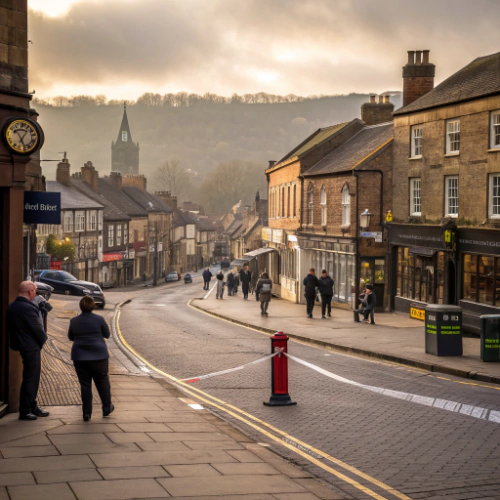
When an accident happens in a public area, uncertainty about responsibility often stops people from taking things further. In Wirksworth, injuries on pavements, car parks, green spaces, or shared access areas frequently raise a simple question with a complex answer: who was legally responsible for keeping the area safe?
Public-area accident claims focus on identifying legal control, not assumptions about ownership or who was nearby at the time. Understanding how liability is mapped helps clarify whether an injury may have been avoidable and whether seeking advice is worthwhile.
Liability in public areas is often unclear
Everyone uses public spaces, but specific organisations maintain them. Councils, private companies, managing agents, or contractors may share control over inspection, maintenance, and repair.
A pavement may be owned by a local authority but maintained by a contractor. A car park may sit next to a retail site but be operated by a separate management company. Communal areas may be overseen by a housing association rather than residents themselves.
Liability is based on who was responsible for the area, not who owns the land.
The legal duty behind public-area responsibility
The organisation responsible for a public area is obligated to take reasonable care to prevent foreseeable harm. This includes inspecting the area, maintaining surfaces, repairing defects, and addressing hazards within a reasonable timeframe.
The law does not expect public areas to be risk-free. It expects foreseeable risks to be managed properly. Liability is assessed by examining whether reasonable systems existed and whether they were followed in practice.
Parties commonly responsible for public areas
In Wirksworth, responsibility for public areas may sit with different bodies depending on location.
Local councils often manage pavements, roads, and public parks. Private companies may operate car parks, shopping areas, or leisure facilities. Managing agents or housing associations may be responsible for communal areas within residential developments.
Identifying the correct party is a key early step and is often less straightforward than people expect.
When can one challenge responsibility?
Not every public-area accident results in liability. Disputes often arise where a defect developed suddenly and there was no reasonable opportunity to repair it.
Responsibility may also be challenged if clear warnings were in place and ignored, or if inspection records indicate that reasonable checks were carried out shortly before the accident.
Each case is assessed on evidence, not assumptions.
The role of evidence in liability mapping
Public-area accident claims are evidence-led. Photographs of the hazard, witness details, incident reports, and medical records help establish what happened and when.
The determination of reasonable care often relies heavily on inspection schedules, maintenance logs, and repair records. Early documentation is crucial, especially when conditions change or repairs occur shortly after an incident.
Shared responsibility and contributory negligence
In some cases, responsibility may be shared. If an injured person failed to take reasonable care for their safety, compensation may be reduced rather than refused entirely.
Such an outcome does not remove the need to assess whether the responsible organisation met its safety duties. Shared responsibility is a matter of degree, not an automatic reason to deny a claim.
What happens once liability is established
If liability is established, compensation may reflect pain and suffering, loss of earnings, medical expenses, and any ongoing treatment or support required as a result of the injury.
The purpose of compensation is to address the impact of the injury and not penalise the organisation responsible for the public space.
Time limits still apply
Accidents in public areas are subject to time limits, usually three years from the date of the incident. Waiting too long can make claims harder, particularly if hazards are repaired or records are no longer available.
Early advice helps clarify liability while evidence is still accessible.
How Marley Solicitors can help
Marley Solicitors provides advice to clients in Wirksworth and the Midlands who have sustained injuries in public areas. We help identify who may be legally responsible, assess whether safety duties were met, and explain options clearly and realistically.
Our focus is on evidence, responsibility, and helping you decide whether pursuing a claim is appropriate.
Liability for public-area accidents depends on control, evidence, and whether reasonable care was taken to manage foreseeable risk.